Showing posts with label Teacher PD. Show all posts

Friday, March 31, 2023

Special Education VS General Education

It's Not Click-bait!

Or, I didn't mean it to be. I just have been thinking a lot about this quote:

"Special education students are often general education students first." 

I have no idea who said that first, or even if it's a direct quote from anyone. What I do know is that when I see people argue against evidence-based, systematic reading instruction - and they do argue against it - often one of their talking points is that THOSE are the only students who need the heavy phonics drills and constant practice. Now, not addressing the "otherness" that people use for students who struggle and students who have disabilities...okay, I will address that briefly:

Sorry, I have to sidebar for this: You know people who believe in nurturing young readers with reading nooks and picture books to make happy learners are often the same people who do not beleive in the science of reading? They believe that you can make life-long lovers of reading if you just give them a comfy place to sit and interesting books to "read" (It's not really reading). These are also the same people who are just not concerned about the OTHER 20% (more like 40%), because they have a disability or a reading difficulty. They will say that THOSE kids are getting special education and so general education teachers don't need to be concerned about that. 

I'm making sweeping generalizations here and I don't mean to sound anti-teacher. Teachers are only as good as what they know, and many are not taught in their teacher preparation programs how children actually learn to read. And school districts have NOT picked up the slack for this lack of education and understanding. Also, this has been going on in Teacher-Prep programs for decades, so it's self-purpetuating now. UGH. 

And don't even get me started on using poor instructional practices in gen-ed and then expecting SPED to fix it!

But here's the key:

There are rarely students who come into school (kindergarten) with an IEP for a learning disability. (Some kids are going to come into school with an IEP - it's called something else in pre-k - already in place, generally, that's going to be students who are maybe in life skills classrooms or who have a visible disability. I can't speak to that experience because I'm just not familiar enough with it, so in this context, we are really talking about learning disabilities in reading, and in NO WAY do I want to diminish the struggles of the kids with other disabilities because when it comes down to the systems that hurt our kids, those systems are the same. That may be a conversation for another day.) And, there isn't really any reason that a student should come into K with an identified reading disability. So, that student is in the general education classroom. That student will stay in the general education classroom. If that student has no real behavioral concerns, they will simply slip through the cracks while they sit in the corner and look at the pictures in books while the teacher tells the parent that they will just get it one day.

UNLESS...unless all the students in the general education classroom are given evidence-based, cumulative, systematic instruction (or structured literacy, whatever you want to call it), AND that teacher has been trained in how children learn to read based on years of evidence from brain science and education research (among other things), AND that teacher continues to get high-quality professional development and coaching about and in the science of reading. AND that teacher has an administration in her building who ALSO understands how kids learn to read and supports her in her endeavor to get all her students reading.

THAT teacher, will see a student who continues to struggle even with high-quality instruction and can say, that child needs more help, let's put him in a smaller group, let's get him some additional instruction, let's give him more opportunities to respond. AND, if that doesn't work, she can say, let's talk about referring this child for an evaluation for special education. And let's actually have that referral in place by the beginning of first grade...and while we are at it, let's not wait! Let's go ahead and put that child in a one-on-one situation with a teacher, or a small group that is really going slow because they haven't reached mastery yet. Let's do that BEFORE the IEP is done!

This doesn't have to be so difficult!

I don't mean that this doesn't have to be difficult for that teacher or that student. This stuff IS difficult. It's hard to be a teacher and it's hard to be a student with a disability, but when you have teachers who are not trained appropriately, who are inadvertently doing more harm to students by using outdated methods to "teach" reading, that only makes it exponentially harder for everyone involved. 

So it begs the question - WHY ARE WE STILL DOING IT THIS WAY?

There are so many free resources out there it's ridiculous. I was just looking at the OregonRTIi website and they have SO many great FREE resources! 

Sidebar: don't get me started with the people who say RTI is a wait to fail model. It's NOT. It gets implemented that way in a lot of places, and they are doing it WRONG! Also feel free to check out MTSS which is very similar and doesn't have the baggage that RTI has (even though they are really similar). Again, I am specifically talking about RTI as a response to poor reading outcomes, not anything else that districts may be using Response to Intervention for. I'm looking at this strictly through the lense of how a response should happen if a child is struggling to read.

Resources

Professional Development does not have to be super expensive! There are loads of resources out there that are free or inexpensive. 

Oregon RTIi

  • Video Recordings and Modules - So many great recordings from really knowledgeable presenters. Scroll down to the videos, but also don't miss the modules at the top!
  • The Science of Reading Professional Development Modules -  Do you need to deliver some PD in your school or district? Don't know where to start with the Science of Reading? Oregon RTIi has already done the heavy lifting for you! From the website: "These slide decks are intended as a resource for school leaders who provide professional development for staff in the area of literacy."

BU Wheelock Forum 

I just listened to this today and I was so inspired by the people out there trying to solve this problem and coming at it from so many different lenses. Really great stuff here.

Tuesday, October 18, 2022

Does the Literacy Curriculum Matter?

 Absolutely, but with a caveat. 

So, it turns out that it's REALLY hard to find a good Language Arts curriculum. The textbook publishing industry is a juggernaut and is bloated with cash and the want of more. In turn, they bloat their products with gimmicky things: lots of colors, pictures, manipulatives, puppets, and hopefully some decodable books somewhere in the mix. 

Also, all programs are not created equal. It's important to check the evidence behind a program - but that is also difficult. There are a couple of websites out there that will give you decent information about curriculum, but many of them are difficult to navigate or the information is given without much context. Personally, I think that EdReports is the easiest to follow and understand - here is the Wit & Wisdom Entry - but to be fair, I don't actually know what the EdReports criteria is for reviewing things. Many programs don't even show up on the other websites (What Works Clearinghouse, NCII, Evidence for ESSA) because the criteria for review wasn't met. That means that the research wasn't done in such a way that it qualified for review. Also, I feel like EdReports provides opinions based on the research which is not what you'll find on those other websites. If you want to do your OWN research into curriculum, you can check out The Reading League's Curriculum Evaluation Tool.

All that, which sort of took me into the weeds a bit, is to say that you can have the BEST curriculum out there. Maybe it follows an amazing scope and sequence and the evidence is that kids learn to read at a greater rate than kids who are not getting what we will call Magical Program

And here's your caveat...

But if you still have teachers who are telling kids to guess a word by looking at a picture, or to figure out the word from context, or to see if it "sounds right," then all the evidence in the world is not going to make that program work. 
Evidence is only as good as the fidelity with which the program is implemented. 

I cannot stress enough how important it is for teachers to STOP TELLING KIDS TO GUESS WORDS BASED ON PICTURES! It is harmful to EVERYONE, even the kids who do learn to read without proper instruction! Those kids who learn to read without proper instruction? Many of them will develop problems later - when they no longer have pictures and the words are more complex. 

I'm cautiously optimistic about the implementation of Wit & Wisdom in our school district. It's a pretty good  program and it does have a scope and sequence. It also builds upon prior knowledge which is very important. 

What am I worried about with the implementation of the new Wit & Wisdom? 

Off the top of my head:

  • Will there be continued coaching for teachers who are using the program? 
  • Is the professional development deep enough and are teachers engaging in that professional development? 
  • Will the district actually implement an MTSS-R system so that there is a process for what to do when a student IS NOT making progress? 
    • Even Magical Program will not work for all students at the same rate. Students with dyslexia and other reading struggles will still require more intensive instruction.
  • Will schools continue to implement the program with fidelity through the upper grades? Ideally, putting a good Tier 1 program in place should stem the flow of kids into Tier 2 and Tier 3, but if you stop teaching reading after 2nd or 3rd grade because you've arbitrarily decided that that's when kids switch from learning to read to reading to learn, you're going to be right back where you started.
  • What about the kids we've already failed? What about my son who is still struggling with reading in high school and who NEVER learned to write well (dyselxia also impacts writing and organizing thoughts around writing). Are we going to implement anything for them?
I fear the answer to that last question is no. There is no time for my son to get all his credits in high school and take a remedial course in reading or writing. So I will continue to pay a tutor to help him with reading. I may have to find someone to help with his writing - but since I was a creative writing major and it's kind of my jam, I think I can help for the time being. But this assumes that he will actually let me help him.

I hate to end on a low note, but facts are facts. I am going to drop a few resources here to help with some understanding:

Not sure what I'm talking about when I discussed Tiers of Support? Check out this graphic (designed by the lovely people at the Lead for Literacy Center (L4L) and then polished into a graphic by yours truly (I am part of the Lead for Literacy dissemination team). You can read the brief that goes with the graphic too. L4L has a ton of really great resources for school, district, and state level leadership - because everyone from top to bottom should understand what good reading instruction looks like.


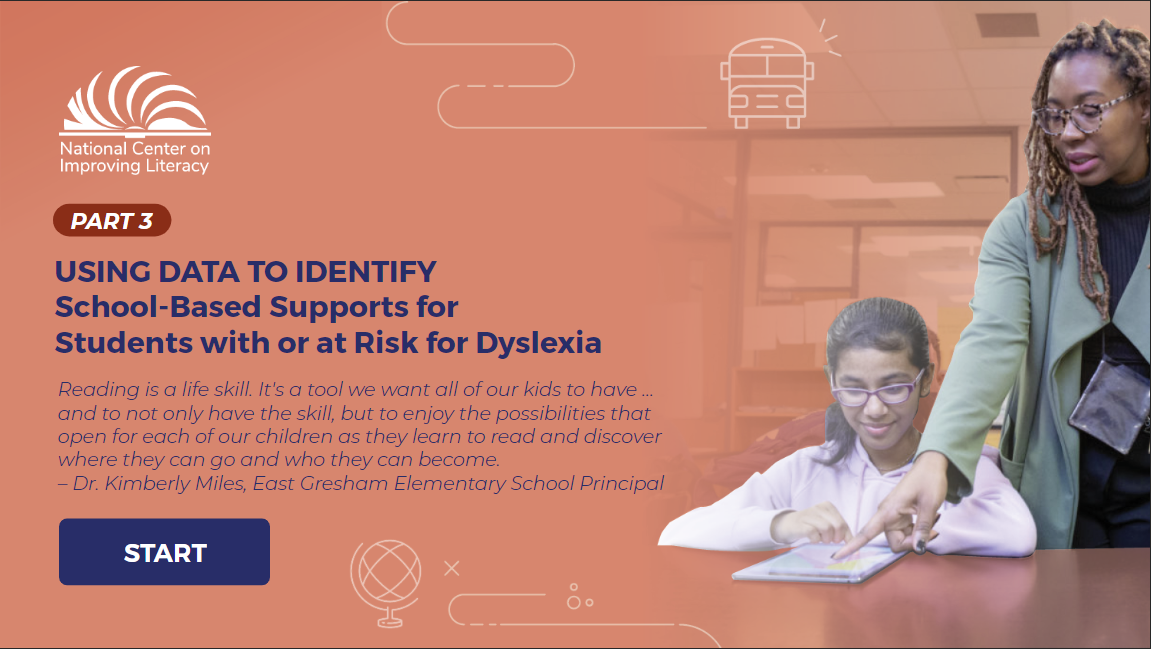
Lastly, the new NCIL Supporting Students with Dyslexia Toolkit. This houses Understanding Dyslexia as well as 4 brand new Toolkits and Tutorials. And here's a tip

Whispering: reading instruction for students with or at risk for dyslexia is good for ALL students. So, even though these things say "Dyslexia" everywhere, this information is really good information for all teachers and parents.

Thursday, September 15, 2022

Make Your Voice Heard! Oregon's New Literacy Framework

 The Oregon Dept. of Education is asking for feedback from stakeholders: educators and families about literacy support! Please complete this survey!

K-5 Literacy Framework - Community and Professionals Input Survey


Here's what I wrote: 

Needs for teaching literacy

Every teacher needs training in how to teach based on the Science of Reading with deep dives into professional development in systematic, evidence-based reading instruction.

Every elementary school teacher should get training in LETRS or a similar program to help them understand what they need to do to teach reading. Programs in addition to LETRS are: The Reading League Online Academy, CORE Learning Accelerated Reading Achievement with the Science of Reading, AIM Institute for Learning & Research Pathways to Proficient Reading Course, The Center for Literacy and Learning has a couple of options for virtual coaching and online learning, The Big Dippers, EBLI For educators, and Keys to Literacy Keys to Beginning Reading PD course.

The state needs to get involved in Higher Ed Colleges of Education. They need to be teaching future teachers how to teach reading. It needs to happen NOW. Look to Eastern Oregon for a model.

Literacy priorities

That schools are NOT teaching our children to read. Just providing a list of evidence-based programs to choose from isn't enough. Teachers need systematic professional development to get them to STOP asking kids to guess words based on pictures and context. If the teacher continues to use strategies that are proven to not effectively teach most kids, even the most evidence-based program is not going to help.

Ongoing support is KEY. Literacy coaches should be funded, and they should have extensive knowledge in how to teach reading effectively.

As part of that ongoing support, providing PD around effective ways to use data to support students often gets pushed aside. Schools do the required screening, but if they are still looking at data in first grade and saying things like, "oh, he's fine, he'll catch up, so he doesn't need any help," that data is useless. Often data is collected but there are no tiers of support and that is how kids fall through the cracks.

Helpful strategies

Systematic, evidence-based instruction based on the 5 big ideas of beginning reading (phonemic awareness, phonics, fluency, vocabulary, comprehension), Instruction should be evidence-based, engaging, systematic, cumulative, and explicit.

Data-based decision making - using screening data to make sure that students who need additional instruction and intervention are actually getting it.

Tutoring or intensive intervention for students in middle school who lost so much in the last few years of elementary school.

What questions do you have for ODE about the Literacy Framework or revisions?

I want to know if schools and districts will get professional development around literacy and the Literacy Framework. Again, making changes to the literacy framework so that it aligns with best practices in teaching reading, isn't going to change anything at the school level unless PD is provided and ongoing support happens for ALL schools.

What else should we know about you and why you are invested in literacy education for Oregon's children?

My son was diagnosed with a specific learning disability in reading and writing just after the 2nd grade, but it took us 3 months after he started 3rd grade to get him any services. He never once met any of his goals on his IEP, and the ONLY reason he's ever learned to read is that I shell out thousands of dollars a year to have him tutored with instruction that aligns with the science. I didn't trust that the school would take care of him or help him and I was right.

Thursday, July 21, 2022

Thoughts on LETRS Training for Teachers

EdWeek just posted this article about LETRS Training that I found very interesting. You can check the article out here: What Is LETRS? Why One Training Is Dominating ‘Science of Reading’ Efforts

First, let's talk about what LETRS is. 

The briefest explanation is that LETRS is a professional development program that helps teachers understand how children learn to read and the basics of how to teach foundational reading skills. Or if you want a more commercial definition, you can check out the Lexia Learning site for LETRS

How does this relate to Oregon? And specifically, Eugene, OR?

Decoding Dyslexia Oregon made a profound shift right after the 2019 NAEP report came out (this report basically says that only Mississippi children made any gains in learning to read by 4th grade), to focus on getting teachers trained in LETRS. This shift was from that focus on dyslexia to a focus on teaching all kids to read the way that all kids can learn to read. However, DDOR is mostly active in the Portland area and that's where the focus has been. Here in Eugene, not so much. There is a relatively young chapter of DDOR in the Eugene area, but I haven't been involved in most of that because it was just getting off the ground when COVID hit. 

Slowly, the LETRS information has trickled into the ears of Eugene's teachers. 

Did you know that Bethel School District has been aligned with the University of Oregon educational research community for decades? Most Bethel schools are teaching reading using evidence-based, systematic reading instruction. Or, they were the last time I knew anything about it which was maybe 5 years ago?

Did you know that 4j schools are so decentralized that they all do things completely differently? Some schools follow evidence-based instruction and some don't and even though they are all supposed to use the same language arts curriculum, some of them just don't use it. (Not that this is a big deal when your curriculum is kind of crappy to begin with)

Did you know that there are about 200 local teachers who are going through LETRS training? 

Did you know that even though school districts could have used COVID money to pay to get their teachers trained, that the teachers getting LETRS training locally are getting it through funding from the United Way?

Why am I asking all of these questions? Possibly because I'm enraged that our largest local school district wouldn't fund such important training...possibly that I feel my question marks drip with sarcasm and disgust.

Thoughts about LETRS

Is LETRS the only option? It's absolutely not. 

Is it the only option that people generally know about and will help increase teacher knowledge about evidence-based reading instruction? Yes. 

Does something need to happen RIGHT NOW to help teachers teach kids how to read? Absolutely. 

Is LETRS too expensive? Probably, but we have to start somewhere and this is what is readily available. Administrators have heard of it because Mississippi was the only state to make gains in reading and it's what they used. 

Is LETRS a cure for what ails schools' ability to teach reading? Probably not? I think that you can't just provide LETRS training to teachers and expect that things will be magically fixed. There has to be a fundamental change at the district (or state) level. If the district doesn't think that they need to teach kids how to read (obviously district leaders wouldn't characterize it this way, but this is what it IS), all the LETRS training in the world isn't going to shift the needle. 

However, is it a bad thing to inform teachers that perhaps they've been doing it wrong all along? NO! Please TAKE LETRS TRAINING if that is all that is available to you as a teacher. The more teachers in your district who are in the know, the more pressure that can be put on school boards and administrators to make giant shifts in the way that reading is taught in our schools! Because make no mistake, giant shifts NEED to happen so we don't continue to create a population that is semi-literate. 

What are the other options?

I'm going to preface this by saying I really know nothing about any of these trainings. Some of them are going to be less intensive and some are more intensive. What I do know is that they are all (in relatively good faith, if with an eye to profit) trying to get evidence-based instructional practices into the hands of teachers. So, I'm not rating these things and I'm not putting them in any particular order. This is just informational. 

  • The Reading League Online Academy. Also an introduction to Basic Reading Instruction for Parents
  • CORE Learning Accelerated Reading Achievement with the Science of Reading
  • Fun fact: Carrie Beck who used to run the CTL Reading Clinic and who used to be the state level dyslexia specialist for Oregon is the Director of Literacy at CORE.
  • AIM Institute for Learning & Research Pathways Programs Pathways to Proficient Reading Course
  • The Center for Literacy and Learning has a couple of options for virtual coaching and online learning. 
  • Fun fact: They put on a fabulous conference every year called Plain Talk about Literacy and Learning. It's in New Orleans and always attracts the big names in the science of reading community.
  • The Big Dippers This is a condensed course but is also inexpensive comparatively. 
  • EBLI For educators, but also they have what I think are free resources for Parents
  • Keys to Literacy Keys to Beginning Reading PD course. I've heard good things.

Final Thoughts

Don't discount the free resources! Almost every one of those organizations above also has a host of free resources that can help you get started if you don't have funding or support from your district. 

And you can always check out the Educate Yourself and Online Resources sections of this website.


Navigation Tips